Inputs
- Your current situation
- The question you need answered
Outputs
- A clearer answer to the question
- A practical next step to take
How are you feeling?
5
Moderate
9
Prompts in Deck
🧠
Reframe
Your Mantras
"Control the first mile. Attack the last mile."
Cognitive Reframes
Reframe: "I'm nervous" → "I'm excited." Research shows the physiological response is identical — butterflies mean you're ready, not scared (Brooks, 2014).
Challenge the "What If": Write down your worst fear for today's race. Now ask: "What's the most LIKELY outcome?" Most catastrophic thoughts have less than a 5% chance of happening.
Focus on Process, Not Outcome: Instead of "I need to PR," think "I will execute my race plan." You can't control your time. You CAN control your effort and pacing.
The 10-10-10 Rule: Ask yourself — will this race matter in 10 minutes? 10 months? 10 years? It will give you perspective and release the pressure.
Name the Emotion: Say to yourself "I notice I am feeling anxious." Simply labeling the emotion reduces amygdala activation by 30% (Lieberman et al., 2007).
Visualization Scripts
Picture mile 3 of a 5K. You are hurting, but so is everyone else. You pass the runner in front of you. Their shoulders drop. You are the hunter. You can see the finish. You kick.
Body scan: Start at your feet. They feel strong. Move to your calves — loose and ready. Your quads are loaded springs. Your core is a pillar. Your shoulders are dropped. You are a machine built for this.
Mantra meditation: Pick your one-word mantra — "Strong" or "Smooth" or "Fly." On every exhale, repeat it in your head. Let everything else dissolve. Just the word and the breath.
Use this in practice
- Use this tool on the bus ride to the meet — 20 minutes of focused breathing changes everything.
- Athletes with stress 7+ should do the breathing circle BEFORE warm-up jogging.
- Visualization is a learned skill — practice it weekly in training, not just on race day (Weinberg & Gould, 2023).
race mindset
Practical examples
Pre-race mindset visuals for bus-ride breathing, course visualization, and start-line focus so the engine stays rooted in race-day mental prep.
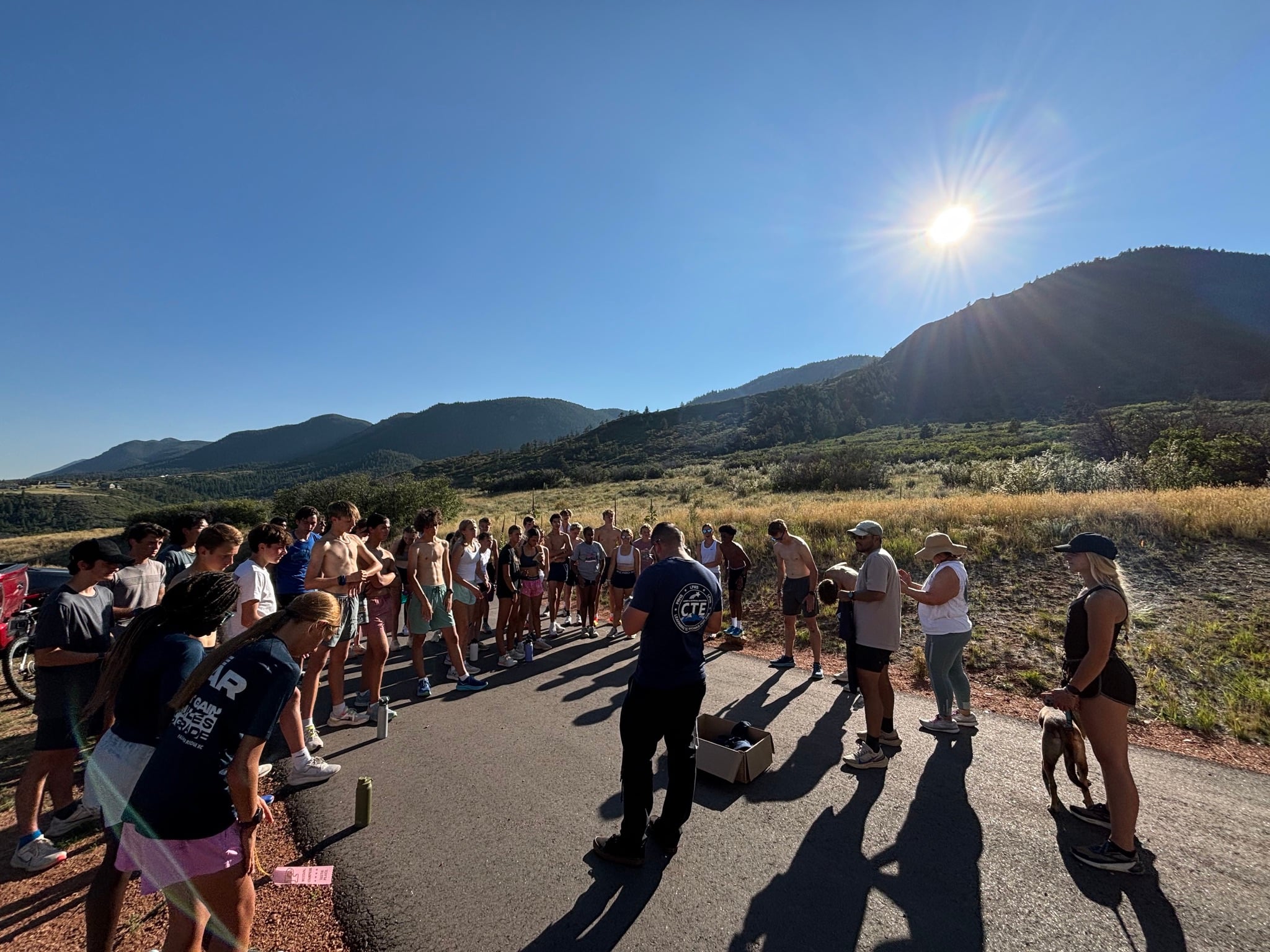
Bus-ride breathing reset
A practical team-routine visual for using breathing before the athlete spirals into meet-day noise.
Breath-and-go routine
A repeatable pattern for the final minutes before the gun.

Pre-race mantra reset
A short mental script that keeps the athlete from spiraling during warm-up.